

Globalisation
National economies and businesses become more connected through trade, investment and technology.
CAIE IGCSE Business 0264 - Paper 1
Why it’s here: Globalisation, exchange rates, international trade, tariffs and multinational businesses.
The main ideas to know for 6.2 Business and the international economy.
National economies and businesses become more connected through trade, investment and technology.

Currency appreciation and depreciation change import costs and export competitiveness.

Tariffs and quotas protect domestic producers but can raise prices and costs.

Operating in several countries brings new markets, resources, risks and responsibilities.
ZRE sells fashion clothing. It is a multinational company (MNC) with 2700 shops in 20 countries. The managing director knows some markets have become more competitive. ZRE offers its 9000 employees training to help them to provide good customer service. Emails are used to communicate with ZRE’s suppliers.
a) Identify two disadvantages for the country where an MNC is located. [2]
TGD is a primary sector business based in country X. It has 6 gold mines and 3000 employees. TGD uses many factors of production. The directors are considering whether to introduce new technology into TGD’s mines. TGD exports 80% of its gold. The managing director is concerned about how changes in country X’s exchange rate might affect TGD’s exports. She knows that TGD’s business activities can negatively affect the environment.
b) Outline two ways the appreciation of country X’s exchange rate might affect TGD when exporting its products. [4]
CPW is a private sector business which has many objectives. It sells electrical goods including kettles and ovens in its 36 shops in country X. CPW also offers a delivery service. The business buys all its inventory from local suppliers to avoid import tariffs. The Finance Director is analysing CPW’s statement of financial position. An extract is shown in Table 2.1. He has been asked to find a source of finance to purchase 10 new delivery vehicles.
| Non-current assets | 120 |
|---|---|
| Current assets | 70 |
| Current liabilities | 110 |
| Non-current liabilities | 75 |
a) Define ‘import tariff’. [2]
NSL is a business based in country X. It manufactures food products including bread and breakfast cereals. NSL uses lean production in its factory. Maintaining quality is important. NSL imports 15% of its raw materials. Changes in country X’s exchange rate can affect businesses which import raw materials. NSL’s Marketing Manager knows the business should respond to changes in consumer spending patterns. She is aware that market research can be used to help make business decisions.
a) Identify one way each of the following changes in country X’s exchange rate might affect businesses which import raw materials. [2] Depreciation: Appreciation:
PKN manufactures glass. Contributing to sustainable development is important to the business. PKN has factories in 30 countries. It has 27 000 employees. The Managing Director knows PKN has benefited from globalisation. She plans to expand the business using external growth. Retained profit is one source of finance a business could use to fund expansion. Some of PKN’s directors are concerned about possible diseconomies of scale as the business grows.
b) Identify two reasons for globalisation. Reason 1: Reason 2:
GAE is a multinational company. It manufactures steel. GAE has 2400 employees and has factories in 4 countries. The business regularly introduces new technology. Holding inventory is important. GAE’s directors are planning to build a new factory and want to know how legal controls over location might affect this decision. The Managing Director said, ‘The new factory will create many external benefits.’ (e) Explain two benefits to a business of being a multinational company. Which benefit is likely to be the most important? Justify your answer.
TJK manufactures candles. Contributing to sustainable development is important to TJK. The business uses batch production in its factory in country X. The target market for TJK’s products is females between 20 and 50 years of age. The Managing Director is reviewing TJK’s financial data. An extract is shown in Table 3.1. He is also considering the benefits to a business of becoming multination company.
| Working capital | 900 |
|---|---|
| Profit | 400 |
| Revenue | 1000 |
c) Identify four benefits to a business of becoming a multinational company. [4]
FSW is a multinational company with operations in 6 countries. It manufactures steel for use in the construction industry. Quality assurance is used to ensure quality production. FSW has many stakeholder groups who are interested in its activities. The Managing Director knows FSW’s business creates external costs. She is aware that pressure groups try to influence business decisions.
d) Explain one possible benefit and one possible drawback to a country of having FSW (a multinational company) operating there. [6] Benefit: Explanation: Drawback: Explanation:
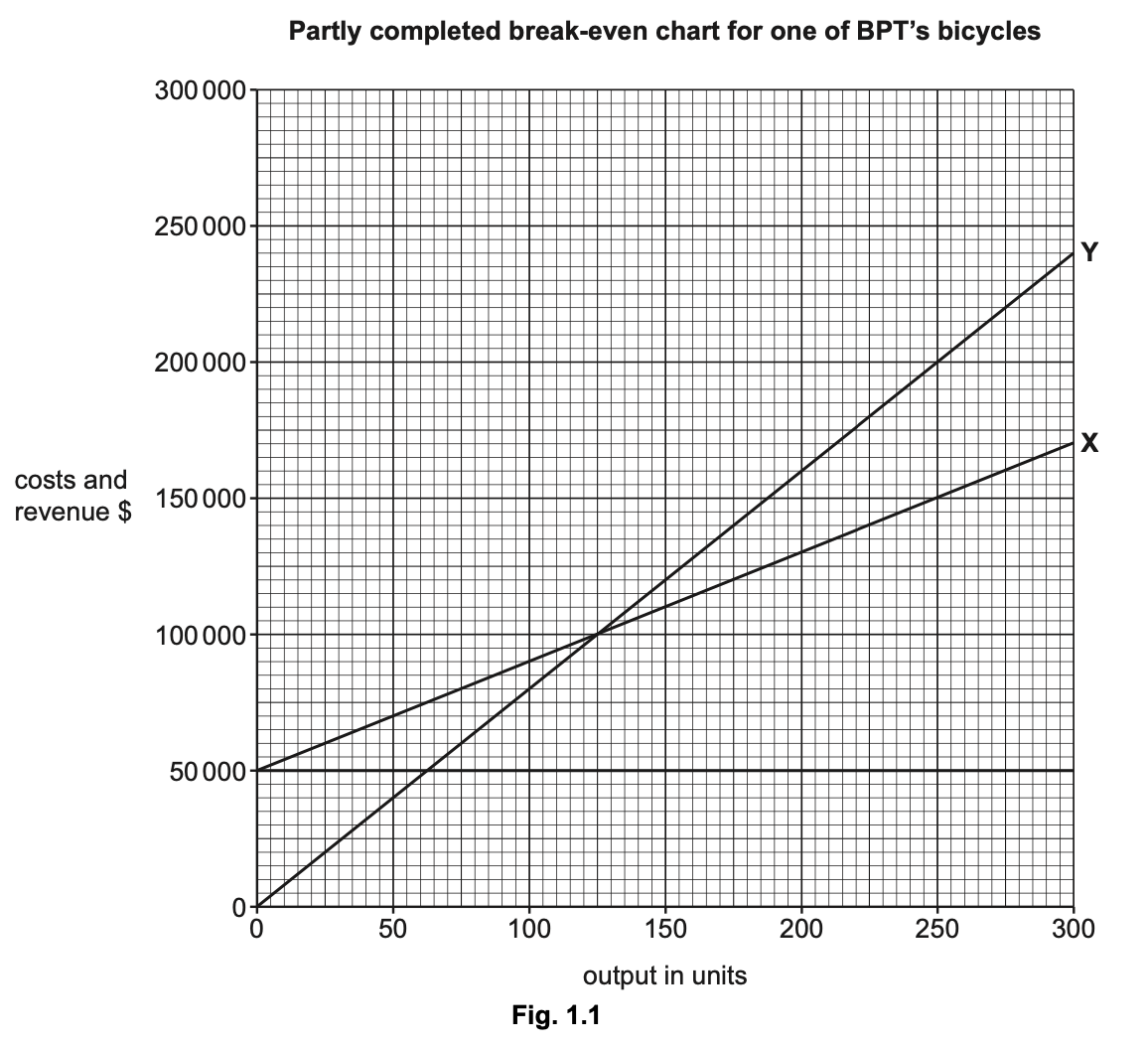
BPT manufactures bicycles in country A. It uses batch production. The Operations Director is preparing a break-even chart for one of BPT’s bicycles, as shown in Fig. 1.1. The directors are considering ways to lower BPT’s break-even level of output. BPT imports 60% of its raw materials and exports its bicycles to 8 countries. The Managing Director wants to know how a depreciation in country A’s exchange rate and the introduction of import tariffs might affect BPT.
b) Define ‘import tariff’.[2]
d) Explain two ways a depreciation in country A’s exchange rate might affect BPT.{4} Way 1: Explanation: Way 2: Explanation:
IDT manufactures clothes for the mass market. It is a multinational company with factories in 4 countries. IDT has short-term and long-term financial needs. The Finance Director is analysing IDT’s statement of financial position. An extract is shown in Table 3.1. He has been asked to calculate working capital and to explain how an increase in non-current liabilities might affect IDT.
| 2022 | 2023 | |
| Current assets | 380 | 420 |
| Current liabilities | 250 | 280 |
| Non-current liabilities | 300 | 400 |
(e) Explain two advantages to a business of being a multinational company. Which advantage do you think is likely to be the most important? Justify your answer. [6]
DLT manufactures cups and plates in country X. Its factory uses flow production and has 75 employees. The Human Resources Director is aware that there are many legal controls over employment. DLT exports 30% of its products to country Y where it benefits from lower rates of taxation and no import quotas. DLT’s Managing Director is considering relocating its factory to another part of country X to meet the increased demand for its exports.
a) Define ‘import quota’.[2]
FR is a multinational company. It has hotels in 18 countries. FR wants to expand into a new market and is planning to build another hotel. FR’s Marketing Director is considering how the market can be segmented. FR’s Financial Director is considering which source of finance to use to fund the expansion. He is also constructing a cash-flow forecast for the new hotel’s first year of trading.
d) Explain two advantages to FR of being a multinational company. [6] Advantage 1: Explanation: Advantage 2: Explanation:
HCB manufactures cars in country X. It has 200 employees working in its factory. The business has changed its method of production due to new technology. HCB’s Managing Director is considering ways to become more ethical. She is aware that other businesses in country X have started to import cars. The interest rate in country X has increased due to rising inflation. (e) Do you think manufacturing businesses will always benefit from the introduction of import tariffs? Justify your answer. [6]
A short rewarded ad helps keep these topical past-paper pages free.